


Businesses exist to solve customer problems for money. Customers are experts at their problems. Great companies understand customers problems better than competitors, and build more relevant solutions. The advantage comes from keeping the two connected.
The cliche quote by Henry Ford "If I had asked customers what they want, they would have said a faster horse" is horseshit (sorry, not sorry). Customers do know what they want. They just don't know which vehicle will get them there (pun intended).
Your customers may know very little about your industry. They probably haven’t read your strategy. They have not memorized your mission statement and cannot recite your values (nor have most of your colleagues).
Most customers would struggle to explain your positioning, despite the considerable effort that went into crafting it, tasting words and meaning like a vintage wine, together with an expensive strategist (like myself).
But they know what it is like to need something, struggle with it and settle for an imperfect solution.
They experience the confusing instructions, the disappointing result, the product that almost fits their life. They can tell you why your "one-size fits all" proposition leaves them feeling like your brand is missing something. And most importantly, they can often tell you why they chose your brand, or why they didn't. That is expertise worth listening to.
In Brief
Customers live with the problems businesses are built to solve. Businesses bring a different expertise: designing, developing and delivering solutions.
Better decisions come from connecting the two. Ongoing qualitative listening helps a company understand what people value, how they experience the brand and what influences their choices. Repeated over time, it can challenge assumptions and inform strategy, marketing, innovation and customer experience.
Yet, most companies are way too distant from their customers, relying mostly on quantitative research that give them averages, charts, and percentages that inspire very little fresh thinking for strategy, marketing, and innovation.
They Live With What You Are Trying to Solve
Inside a company, a problem can acquire remarkably abstract language.
“Improve the customer journey.”
“Strengthen the value proposition.”
“Remove barriers to conversion.”
Outside the company, someone is trying to work out whether the product will fit in their cupboard.
Both descriptions concern the same business. One is considerably closer to the problem.
Consider a hypothetical cleaning product. The company might focus on cleaning performance, ingredients and packaging. A conversation with a customer could reveal that the awkward bottle makes it difficult to use one-handed while holding a child. Or that an overpowering fragrance makes a clean room feel less comfortable.
Or a woman revealing that she hates dipping her fingers into a skincare product in fear of spreading bacteria into the product, all while loving the product itself.
Or a man that said he feels ashamed of buying protein powders in a grocery store because he does not want to be seen as a gym bro.
The customer does not need to design a new bottle or reformulate the product. Their experience gives the business a better problem to solve.
The same applies to desire. People want outcomes, but they also care about how those outcomes are achieved, what the choice means and how it fits their sense of themselves.
Understanding those connections can reveal opportunities that a feature checklist misses.
Expertise Does Not Mean Perfect Explanation
Customers are experts in living their lives. They are not necessarily experts at explaining every influence on their behaviour.
They can forget details, give a convenient explanation or describe what they intended to do rather than what happened. A request for a particular feature may point towards a problem that could be solved in several better ways.
That is why good listening goes beyond asking what people want.
Ask about a specific occasion. What were they trying to do? What happened? What else did they consider? What nearly stopped them? What did they do instead?
Then look across conversations, alongside other evidence.
The company still has to interpret, prioritise and decide. Listening strengthens judgement; it does not outsource it.
The Same Understanding Can Improve Several Decisions
A clearer view of customer problems has value well beyond the research team.
Strategy can use it to decide which customers and unmet needs deserve attention—and whether an apparent opportunity is something the business can credibly serve.
Marketing can learn which questions need answering, which claims need proof and what people struggle to understand about the offer. It can also discover when communication is being asked to compensate for a product or experience problem.
Innovation can investigate the compromises and workarounds people have accepted. Those are useful starting points for developing better propositions.
Customer experience can examine where finding, choosing, buying and using become unnecessarily difficult.
Brand understanding runs through all of them. What do people think you offer? What do they trust you to deliver? Why do they choose you, choose another brand or postpone the decision altogether?
These questions deserve answers before the budget is committed.
Keep the Connection Open
An annual study can be valuable. So can the conversation you have after a launch, after a service change or when customers begin choosing an alternative for reasons you cannot explain.
The purpose of ongoing listening is to keep important questions open to new evidence.
That might mean returning to a few standing questions at planned intervals, with focused studies when a decision needs deeper investigation. You could explore brand perceptions, reasons for choosing, frustrations with first use or the occasions where people turn elsewhere.
Listen across current customers, people choosing competitors and the potential customers you have yet to win. Each can reveal something different.
Repetition also lets you learn after acting. Did the improvement address the frustration? Has the message clarified the value? What remains unresolved?
Different answers do not automatically prove that attitudes have changed; recruitment and circumstances matter. But they can tell you where to investigate next.
Set Up Talk™ Around Your Questions
Talk™, our AI-interviewer makes it practical to hold individual qualitative conversations by voice or text, many at once, and repeat the listening throughout the year.
Original Minds designs the studies around your questions and goals, then interprets what people say for your brand and business. The value comes from understanding what the findings mean for the decisions ahead.
A programme might revisit why people choose your brand, explore what makes others hesitate and investigate specific experience problems as they arise. Each study builds on the earlier understanding.
As part of our broader intelligence system, that customer evidence can also be considered alongside market developments and how your brand stands against the alternatives.
Customers bring their experience. Your team brings the ability to do something with it.
Keeping those forms of expertise connected is a practical way to make decisions with fewer assumptions—and a clearer view of what needs solving.
What would you like to understand better about your customers?
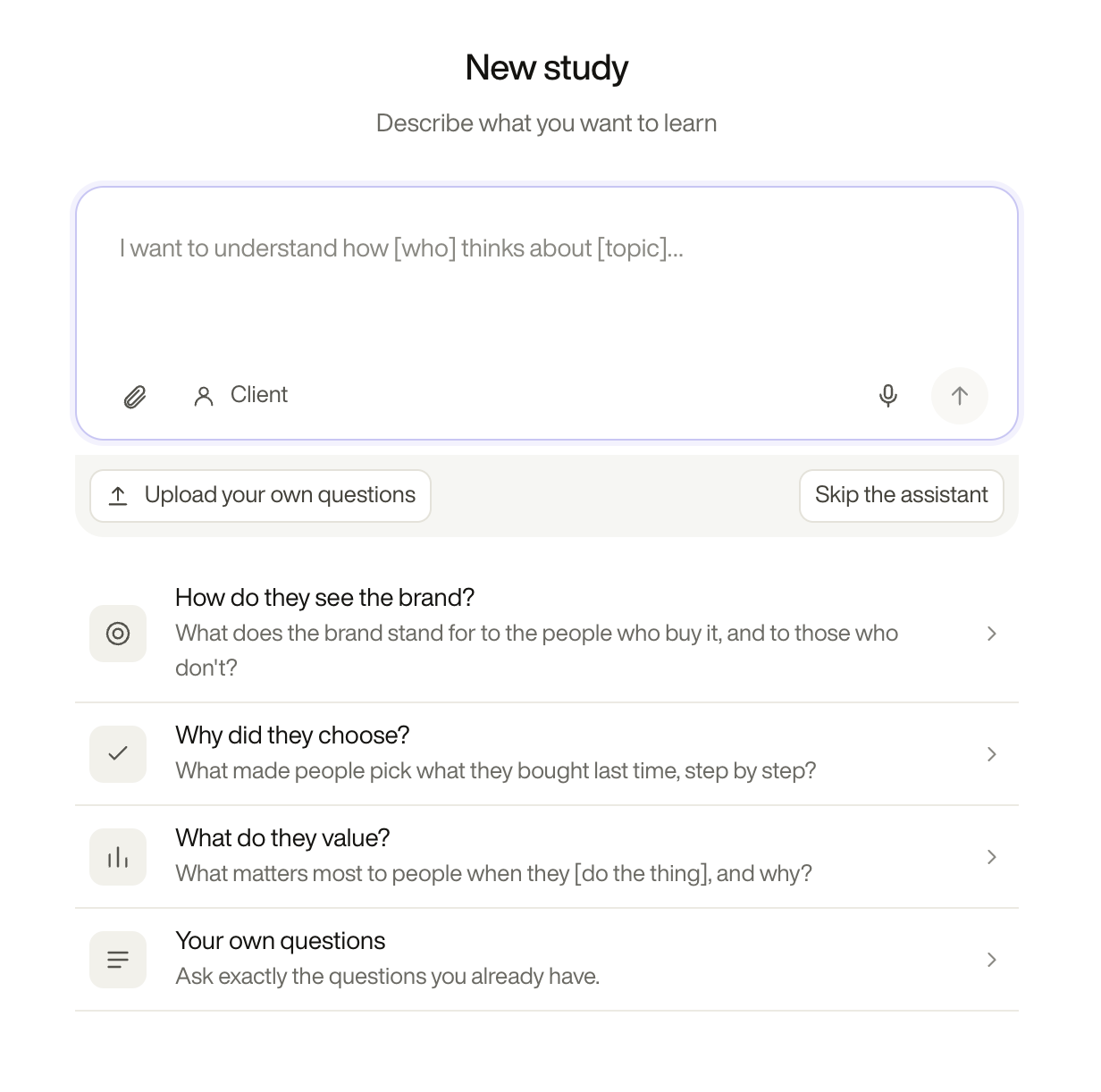
Book a Talk™ demo. We can start with a focused pilot around one question, show you how we interpret the findings for your brand, and explore what would be useful to keep listening to throughout the year.
Written by