The AI Age: The Human + Machine Era

– 5 min read



The Post-Industrial Cognitive Revolution
Artificial Intelligence isn’t coming — it’s already absorbed us.
The average knowledge worker now collaborates more with machines than with their manager. Algorithms are the new colleagues, copilots, and critics. In studios, boardrooms, classrooms, and living rooms, AI has quietly become the third voice in every conversation.
This isn’t the story of technology “replacing” humans. It’s the story of humans re-engineering themselves through technology — cognitively, culturally, and economically.
What electricity was to the Industrial Age, AI is to the Cognitive Age: an invisible infrastructure powering new systems of thought, creativity, and value. But like electricity, it doesn’t care who it empowers — it amplifies the capable and exposes the complacent.
Technology / Culture / Work / Creativity
Region: Global (North America, Europe, Nordics)
Topic: AI Society, Human Futures, Cognitive Economy
There are moments in history when humanity changes its tools — and in doing so, changes itself.
The printing press gave us literacy. The steam engine gave us industry. The internet gave us access.
AI gives us agency — but also ambiguity.
We are entering a paradoxical era: one where intelligence is abundant but understanding is scarce.
Every individual now holds superhuman creative and analytical power in their pocket. A teenager can produce a film-quality commercial in an afternoon; a consultant can simulate a week of market analysis in an hour. Yet in this explosion of ability, we are losing the sense of what’s ours — our taste, our thinking, our touch.
Culturally, AI has become both muse and mirror. It reveals our collective obsessions — speed, optimization, productivity — and reflects them back in ever more perfect loops. The danger isn’t that AI becomes sentient; it’s that humans become predictable.
Economically, the shift is seismic. We’re witnessing the collapse of creative scarcity. Design, writing, marketing, music — all are being commoditized by infinite replication. When anyone can create anything, the strategic question shifts from how to create, to why, for whom, and with what integrity.
The “AI revolution” isn’t about replacing labor — it’s about rewriting what labor even is.
This is the dawn of AI Society: a hybrid civilization where human intuition, algorithmic precision, and cultural context coalesce into new forms of intelligence. We are becoming a symbiotic species — not human versus machine, but human with machine.

AI has shifted from a technological innovation to a civilizational force.
The critical question for leaders is no longer “Should we use AI?” but “What does our intelligence now consist of?”
For brands and agencies, the implications are existential.
The creative premium — once protected by time, talent, and training — is being flattened by automation. When an algorithm can generate 10,000 ad variations in a second, the competitive advantage moves to conceptual intelligence: the ability to define meaning, not just make things.
For individuals, this is a power test and a values test.
The old equation of value = time + expertise no longer holds. The new equation is value = taste + synthesis + ethics.
We are moving from an economy of effort to an economy of discernment.
AI is not replacing us — it’s revealing us.
It shows, often brutally, which parts of our intelligence are mechanical and which are truly human.
It exposes how much of our “creativity” was really just production, and how much of our “thinking” was repetition.
The deeper transformation is psychological.
Humans have always defined themselves by what they can uniquely do. When machines can also do it — sometimes better, faster, or cheaper — the identity crisis begins. We are forced to rediscover what makes us indispensable: emotion, narrative, intuition, ethics, humor, beauty — the irrational, the poetic, the human.
In other words, AI is pushing us back toward humanity.
Ironically, the more we automate, the more we will value the un-automatable.
In a world of perfect optimization, imperfection becomes luxury. In a world of infinite ideas, taste becomes power.
This is not the end of human creativity — it’s the end of human complacency.
We are watching the Industrial Revolution of the Mind unfold in real time.
Just as the 19th century built factories for the body, the 21st is building factories for the brain.
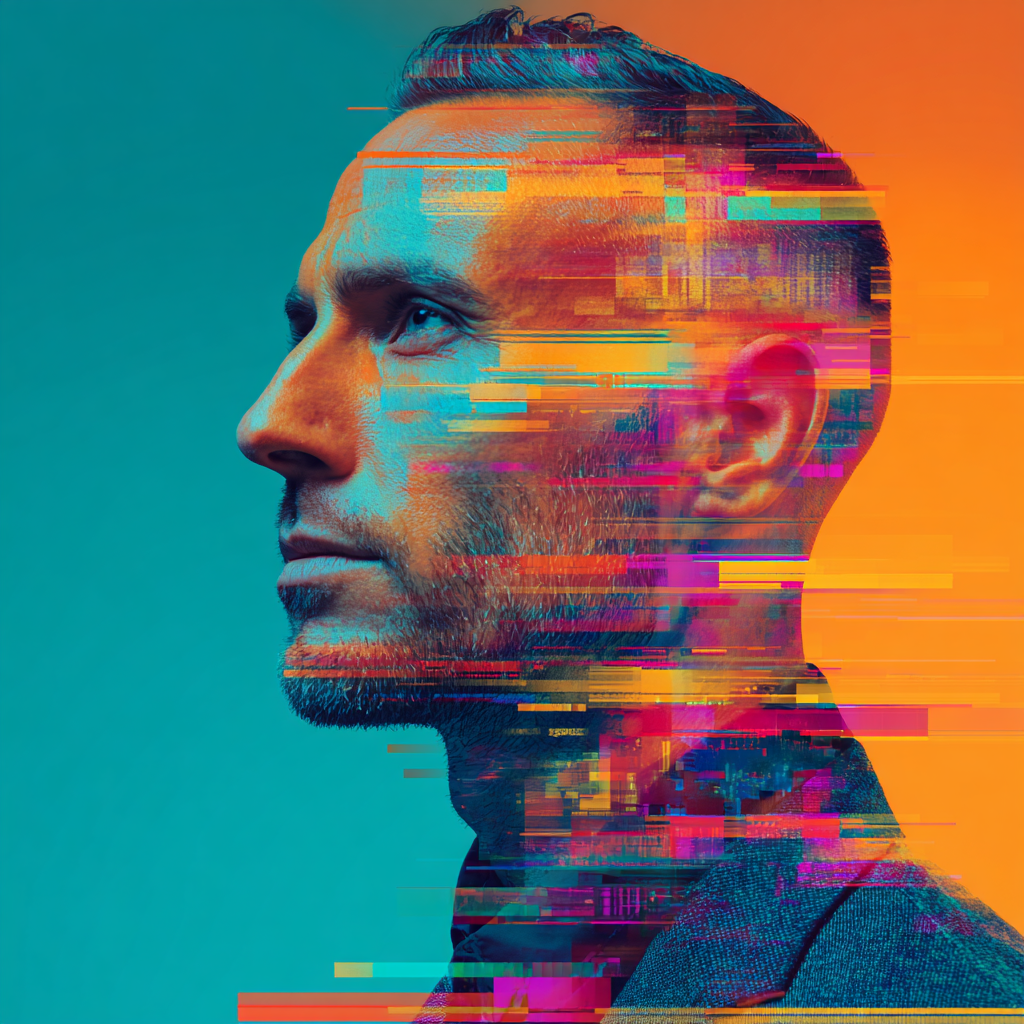
Don’t fight the machine; choreograph with it.
If everyone uses AI, how you use it becomes your brand.
Your future competitive edge is not talent — it’s how intelligence flows.
AI is not a tool; it’s a tectonic plate.
It’s moving everything above it — work, art, strategy, identity.
But every revolution has a human correction.
As machines learn to think, humans will rediscover what it means to feel.
The ultimate advantage won’t be intelligence — it will be insight.
Not just thinking faster, but thinking deeper.
In this new era, the question isn’t “Will AI take my job?”
It’s “Will I still be worth listening to when it does the easy parts for me?”