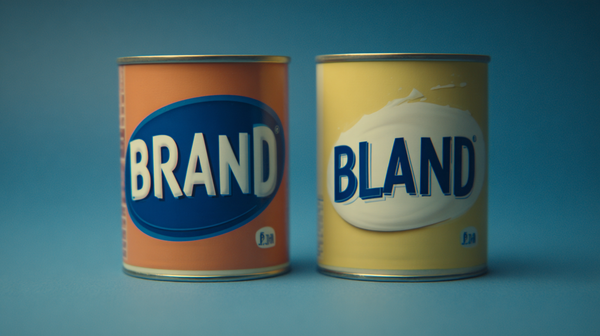


In Brief: The cultural moment is rewarding brands that look like they've stopped trying. Which creates a problem. Because the moment you try to stop trying, everyone can tell.
There is a memo going around marketing departments right now. It has different subject lines depending on the company, but the content is roughly the same. We need to be more authentic. More human. Less corporate. Have you seen what Duolingo is doing?
The memo is well-intentioned. It is also, in a quietly devastating way, proof that the company sending it has already missed the point.
Something real is happening in culture. A generation that has been algorithmically marketed to since adolescence has developed an almost clinical sensitivity to performed personality. They can feel the strategy session that produced the Instagram caption. They can sense the brand guidelines behind the tweet. They know, with uncomfortable precision, when a company is being spontaneous on purpose — and they find it roughly as convincing as a politician doing a shot of tequila at a campaign rally.
The brands breaking through are doing something that looks, from the outside, like they've simply stopped caring about any of this. Duolingo's unhinged owl threatening users in comment sections. Scrub Daddy — a sponge, one of the least inherently interesting objects in domestic existence — commanding genuine cultural attention through content that appears to have been made by someone with absolutely nothing to lose. Liquid Death building a devoted following around canned water by being more committed to their own strangeness than any focus group could ever sanction.
These brands look like they're winging it. They are not winging it. But here is where it gets complicated.
The paradox is this: the quality these brands are being rewarded for — the looseness, the confidence, the apparent indifference to approval — is precisely the quality that cannot be implemented as a strategy.
You cannot put "be more unpolished" on a brand roadmap. You cannot run a workshop on spontaneity. You cannot hire an agency to produce irreverence on a monthly retainer and expect it to land the way irreverence lands when it's real. The committee that has spent three years softening every edge, qualifying every claim, and routing every piece of content through four layers of sign-off cannot simply decide to stop doing that and expect what comes out the other side to feel free.
It will feel like a committee pretending not to be a committee. Which is somehow worse than just being a committee.
This is the trap the memo sets. The senior leadership reads about Off-Script brands and concludes the answer is a tone of voice refresh, a new social media hire, a directive to "take more risks with content." The team dutifully produces riskier content. Legal reviews the riskier content. Brand reviews the riskier content. The riskier content is made significantly less risky. It goes live. Nobody notices. The memo gets sent again six months later with a different subject line.
The output was never the problem. The output is just the symptom.
What the brands doing this well actually have is not a better content strategy. It is a more resolved sense of identity. They know, with unusual precision, who they are and who they are for. They have made the decision — consciously or by instinct — about which customers they are optimising for and which ones they are not. And that clarity, that genuine narrowness of focus, is what makes it possible to say the slightly wrong thing occasionally without it feeling like a crisis.
Duolingo is not nervous about alienating people who find their owl annoying. Those people are not their customer. Liquid Death is not worried about the consumers who find their brand too aggressive. Those consumers were never going to choose canned water with a death metal aesthetic anyway. The apparent recklessness of their communication is underwritten by a very clear decision about who they exist for — and an equally clear decision about who they don't.
That is not a communications strategy. That is an identity strategy. The communications are just what identity looks like when it's been resolved rather than managed.
Most brands have not resolved their identity. They have documented it — in brand guidelines, positioning statements, value proposition frameworks — without ever making the harder choices those documents are supposed to represent. The result is a brand that knows its personality adjectives but cannot act on them in real time without checking whether this particular execution is still on-brand. Which means the personality exists as a description rather than a conviction. And descriptions do not produce the kind of instinctive, confident communication that this cultural moment is rewarding.
The Culture Force™ does not care about your brand guidelines. It shifts based on what people find credible, what signals confidence, what feels like it comes from somewhere real. Right now, in a significant number of categories — particularly those carrying identity weight, where what you choose says something about who you are — that credibility is flowing toward brands that have clearly stopped seeking permission from their audience.
And here is the commercial consequence that makes this more than a Friday observation about funny social media accounts. The brands that cannot access this energy are not just losing cultural relevance. They are losing pricing power. Because the premium a brand can charge above a functional substitute is almost entirely a function of what choosing it signals — to others and to yourself. When a brand's communications read as anxious and approval-seeking, that anxiety transfers. It undercuts the very confidence the customer is trying to buy.
You cannot charge a premium for belonging to something if the something in question is visibly uncertain about what it is.
So what do you actually do with this, if you are a brand that recognises the gap but cannot simply decide to be more unpolished and expect it to work?
The honest answer is that you go back further than the communications. Not to the tone of voice. Not to the content calendar. To the harder questions about who you actually are, who you are genuinely for, and what you believe with enough conviction that you would be willing to lose some people over it. Because that last part — the willingness to not be for everyone — is what produces the clarity that makes everything downstream feel real rather than performed.
The unpolished output is not the goal. It is the evidence that the identity work has been done.
Most brands are trying to copy the evidence without doing the work. Which is, when you think about it, the most on-brand thing they could possibly do.
We continually monitor five forces that shape customer choice. The Culture Force is about the shifts in values, attitudes, social norms, and codes that shift demand, months before it shows up in the numbers.
Written by